

Thank you for Subscribing to Real Estate Business Review Weekly Brief


 Christopher Beatty, CEO
When the monthly HOA meeting begins in most U.S. neighborhoods, the scene is usually predictable: a half-empty clubhouse, stack of printed agendas, volunteer board already stretched thin, and frustrated homeowners wondering why basic questions still take weeks to answer. Small and mid-sized communities are hit especially hard as they pay for management structures designed for larger developments while still struggling with slow communication, limited transparency, and disengaged residents.
The problem isn’t simply inefficiency. The traditional HOA model has become increasingly disconnected from how people actually live. Homeowners want easier participation, board members want less administrative burden, and residents want faster responses and a stronger sense of community.
Red Rock Virtual recognized that the real problem was a system which made community engagement feel difficult, slow and impersonal. Rather than layering technology onto an outdated model, the company reimagined HOA management from the ground up. Meetings moved online, voting became digital, participation surged, costs dropped and in an unexpected twist for a company built around virtualization, neighbors started interacting more. Recognized as a Top HOA Management Company for 2026, it reexamined the role of an HOA management partner and asked what a community truly needs to function well.
“Technology has enabled us to reduce costs significantly for our clients while elevating the overall experience for both board members and homeowners,” says Christopher Beatty, CEO.
A Leaner Model That Delivers More
Red Rock Virtual occupies a middle ground between full-service HOA management and software-only solutions that focus solely on accounting or administrative functions. Each community works directly with a dedicated community manager who provides ongoing guidance and support, while technology handles routine processes that often consume valuable time. Artificial intelligence helps answer common homeowner questions, provide account balances, work order updates, and violation information through direct access to the company’s operating system. Internally, AI equips community managers with real-time insights that support more proactive decision-making and allow greater focus on board collaboration and community projects.
The value of this approach became particularly evident during a recent after-hours water leak incident. Following the shutdown of water service to complete repairs, notifications were sent to affected homeowners through text and email. Although the community received a large volume of inquiries, nearly 88 percent were resolved through AI-assisted responses that recognized the active issue and the caller’s location. This enabled the community manager to concentrate on coordinating repairs with vendors and city officials while homeowners continued to receive timely information.
-
Technology has enabled us to reduce costs significantly for our clients while elevating the overall experience for both board members and homeowners.
Red Rock Virtual’s technology-driven management model replaces slow, paper-based processes with digital workflows and mobile access. Boards, homeowners, and managers can communicate, review requests, and make decisions in real time, improving both speed and efficiency.
Red Rock Virtual’s technology-driven management model replaces slow, paper-based processes with digital workflows and mobile access. Boards, homeowners, and managers can communicate, review requests, and make decisions in real time, improving both speed and efficiency.
Participation also shifts in a meaningful way. Physical meetings often require travel, fixed schedules, and long sessions that discourage attendance. Virtual meetings fit into daily life with far less friction. A parent can join a discussion from home while managing family responsibilities and still contribute to decisions that affect the neighborhood. Red Rock Virtual has seen participation rise by about 50 percent, and that increase brings more voices into the conversation. Greater involvement leads to more volunteers, stronger committees, and a sense of shared ownership that many communities struggle to build.
Technology That Strengthens Everyday Decisions
Technology plays a central role in this transformation, especially through the use of artificial intelligence. Internal systems support budgeting with improved forecasting and early alerts when expenses drift off course. Maintenance patterns receive closer attention, which helps teams identify recurring issues within specific buildings and address them before they escalate. Each community operates under its own set of rules, and AI organizes this information so staff can access it quickly and respond with clarity.
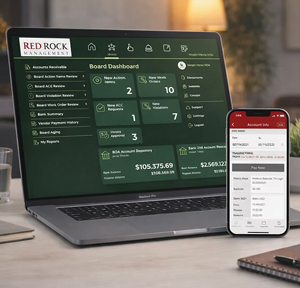 Homeowners experience these benefits in a direct way. A resident can call, text, or use a chat feature to pay dues, respond to a notice, or ask a question about community guidelines at any time of day. The system provides answers based on the specific rules of that neighborhood and turns it into a reliable resource. Human support remains available whenever needed, so the experience balances speed with personal interaction.
Flexibility remains part of the model. Communities that prefer in person meetings can still hold them, supported by detailed materials and optional virtual participation from managers. This balance keeps control in the hands of residents while maintaining operational efficiency.
Future updates point toward a deeper focus on connection through a community platform where neighbors can share resources, organize events, and build relationships within their own network. By expanding beyond traditional property management, Red Rock Virtual is positioning itself as a model for more connected, responsive, and engaged communities where technology supports operations and the resident experience.
Choosing HOA Management That Fits Community Reality
HOA boards are often asked to buy more management than their communities can justify. A small neighborhood with limited amenities still needs accurate dues collection, reliable accounting, covenant support, document access and guidance for volunteer directors, but it may not need a manager driving across town for every meeting or a fee model built around office-heavy routines. The central purchasing problem is no longer whether an association needs professional management. It is whether the management model matches the actual volume, complexity and behavior of the community.
Cost pressure makes that question sharper. Assessments fund visible neighborhood needs, reserves, insurance, maintenance and compliance work, so management fees compete directly with projects homeowners can see. Executives evaluating HOA management should look past headline pricing and examine which tasks create value, which tasks merely preserve tradition and how quickly routine requests move from homeowner input to board action. A lower fee matters only when it is paired with reliable accounting, clear records, predictable communication and disciplined support for board decisions.
The strongest providers now reduce friction in the routine moments that shape resident trust. Architectural requests, violation responses, dues payments, document searches, meeting packets and board approvals should not depend on paper movement or calendar delays. Homeowners expect self-service access, but boards still need control, oversight and human backup when judgment is required. That balance is especially important because every association has its own covenants, bylaws, approval rules and financial priorities. Generic software cannot replace management judgment, while traditional service alone can leave simple requests moving too slowly.
Resident participation has become another measure of management quality. Boards cannot govern well when meetings are inconvenient, voting is cumbersome or homeowners treat the association as a bill collector rather than a shared civic structure. Digital meetings, online voting, mobile access and clearer issue tracking can widen participation without forcing every interaction into a remote format. The better model gives boards meeting materials, financial visibility and action tracking, then lets them decide when in-person discussion adds value. This keeps professional support close to the decision while reducing unnecessary attendance costs.
Financial stewardship should also extend beyond bookkeeping. Associations need timely reports, budget visibility, reserve awareness, payment options and early warning when patterns suggest a larger issue. Maintenance-heavy communities may need stronger tracking across repeated repairs, while smaller single-family HOAs may need leaner support around dues, covenants and communication. The provider should scale service to the association’s actual needs instead of selling the same package to every board.
Red Rock Virtual stands out for boards that want full HOA management support without paying for avoidable in-person routines. It combines flat-rate, transparent pricing with a portal and Red Rock Go mobile app that support online dues payments, violation responses, architectural requests, document access, financial reports, approval workflows and task management. The company’s virtual model also preserves board control through meeting packets, remote manager participation when needed, online voting and resident-facing tools. For associations that need professional structure, faster homeowner access and lower recurring cost, Red Rock Virtual is a strong Gold Standard choice.
...Read more
HOA Management Companies Info
Q1
Technology has become an important part of HOA management, allowing residents to submit requests, pay dues, access documents and communicate with management through secure online platforms. At the same time, experienced professionals bring expertise in budgeting, governance, conflict resolution and regulatory compliance. By combining digital tools with knowledgeable community management, Top HOA Management Companies help associations deliver more responsive service, improve transparency and support well-managed residential communities.
HOA Management Companies help homeowners associations handle the day-to-day responsibilities of running a community. Their work typically includes collecting dues, managing budgets, coordinating maintenance, enforcing community guidelines, organizing board meetings and communicating with residents. By taking care of these administrative and operational tasks, they allow volunteer board members to spend less time on routine management and more time making decisions that benefit the community.
Q2
How Does Red Rock Virtual Differentiate Itself Among HOA Management Companies?
Red Rock Virtual delivers HOA Management Companies services through a virtual management model that combines technology with dedicated professional support. Since its founding in 2009, it has served communities nationwide with dedicated community managers, an AI-powered homeowner portal, online financial management, virtual board meetings and transparent flat-rate pricing. The company also operates without long-term contracts, giving communities the flexibility to continue receiving support while retaining greater control over their management decisions.
Q3
What Should Communities Consider When Choosing HOA Management Companies?
Selecting the right HOA Management Companies provider involves more than comparing service fees. Communities should evaluate communication, financial transparency, responsiveness, technology, vendor coordination and contract flexibility alongside the quality of reporting and resident support. A provider that keeps information accessible and responds consistently can make it easier for boards to address everyday responsibilities while planning for the community's long-term needs.
Q4
How Do HOA Management Companies Improve Community Operations?
Modern HOA Management Companies simplify community management by reducing the manual work involved in everyday administration. Online payments, digital records and streamlined communication help boards and homeowners stay informed without relying on paper-based processes. Faster responses to maintenance requests, architectural reviews, compliance matters and resident inquiries also contribute to a more organized and efficient community experience.
Q5
Why Does Red Rock Virtual Emphasize Virtual HOA Management?
Red Rock Virtual believes HOA Management Companies can serve communities more effectively by combining experienced community managers with technology that simplifies routine tasks. Its platform supports AI-assisted homeowner assistance, online account management, payment processing, document administration, architectural review workflows and maintenance tracking. Bringing these capabilities together helps boards stay organized while giving residents convenient access to the information and services they use most often.
Q6
How Can Communities Measure the Value of HOA Management Companies?
The value of HOA Management Companies is reflected in accurate financial management, responsive communication, efficient operations and satisfied residents. Communities should also consider reporting quality, vendor oversight, board productivity and whether management processes can scale as the association grows. A provider that delivers consistent support while maintaining clear communication and transparent pricing can contribute to a stronger, better-managed community over the long term.
