

Thank you for Subscribing to Real Estate Business Review Weekly Brief


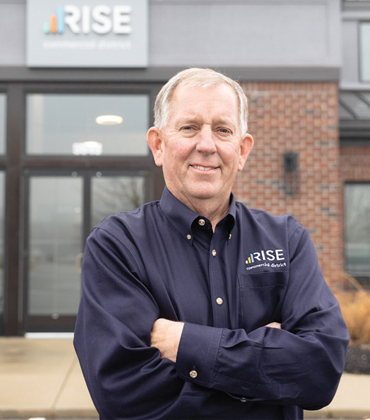 Jim Sapp, Founder & CEO
As businesses transition from early growth to operational scale, space becomes a critical constraint. Entrepreneurs are forced to predict how much space they need in future and to commit to fixed, long-term commercial leases. Beyond base rent, they must also manage and pay for high-speed internet, conference rooms, waste services, security and maintenance, draining capital and attention. With businesses scaling unevenly across digital and physical channels, traditional real estate models cannot support.
What challenges do entrepreneurs face in scaling business space?
RISE Commercial District redefines small-business real estate management by filling the gap between startup and scale with right-sized, flexible and professionally managed business districts. Its value-proposition extends beyond space. RISE functions as a growth enabler, providing businesses with the infrastructure and mentorship—on-site leadership and informal guidance—for faster growth, efficient operations and scale.
“We provide everything a growing business truly needs, and no fluff they do not,” says Allison Barber, director of marketing.
Turnkey Experience Boosting Business Growth
How does RISE Commercial District provide a tailored environment for growth?
From site selection and building design to staffing and tenant onboarding, RISE follows a standardized operating framework built around safety and service.
Secure and community-driven spaces range from 300 to 3,000 square feet under short-term lease structures. Terms are intentionally straightforward, requiring only first month’s rent, which includes utilities and operational essentials, and a security deposit. Entrepreneurs can add space as their business grows, without being locked into multi-year leases.
-
We provide everything a growing business truly needs, and no fluff they do not.
All RISE facilities are gated and equipped with 24/7 video monitoring, allowing entrepreneurs to track activity, review footage if issues arise and maintain visibility over operations, all times.
Surrounded by business owners and operators navigating similar stages of growth, entrepreneurs also gain access to peer learning and practical insight that accelerates decision making. This built-in network of peers and mentors combats isolation, transforming a lonely journey into a supportive experience.
Each district is supported by an onsite district manager who embodies the RISE mentor mindset, serving as a day-to-day resource and trusted advocate for entrepreneurs. The manager supports space planning, operational questions, vendor connections and growth transitions. Centralized systems for access control, security monitoring, maintenance and tenant communication supports local leadership, ensuring every district delivers the same level of care and professionalism.
The mentorship culture extends through RISE’s Build Boldly podcast and educational content, where entrepreneurs share candid lessons on scaling, operations, hiring and leadership.
Instead of spending hours browsing or second guessing decisions, entrepreneurs can ask a neighbor, get perspective from their district manager, listen to a podcast episode or learn from short form content and conversations within the RISE community.
Designed for Entrepreneurs, Built to Scale
How do RISE spaces enable operational efficiency and business growth?
Dr. Zach Thomas, a board-certified podiatrist, was creating content in a basement that slowed production and sapped creative momentum. After moving into a RISE facility, with dedicated room for filming, meetings and operations, he streamlined production, stayed consistent with content and balanced a growing brand alongside his medical practice.
Similarly, TJ Bechill, co-founder of Neat Audio, operated his playback redundancy and automation business from a garage. The blurred boundaries between home and work strained operations and growth. RISE’s dedicated environment provided room for inventory and employees, restored work-life balance and enabled efficient scaling.
RISE is in a period of accelerated expansion, opening three new locations this year. Expansion is guided by identifying markets where small and mid-sized operators face the same gap it was built to solve. Removing barriers at critical moments of growth sits at the core of RISE’s mission, shaping the development of new districts through a lens of reliability and long-term stewardship.
Monitoring evolving entrepreneurial landscape, it sees opportunity in expanding its district model across multiple formats. It includes warehouse, flex, office, studio and emerging hybrid environments and improving facilities, services and educational resources.
Strategically expanding into multiple states, RISE Commercial District continues to help small and mid-sized businesses thrive.
Flexible Commercial Real Estate for Growth-Minded Businesses
Commercial real estate has long favored established operators with predictable balance sheets and multi-year forecasts. Traditional leases often run five to ten years and require significant square footage commitments. They also layer in costs that extend well beyond base rent. Tenants assume responsibility for utilities, maintenance, equipment, waste management and other essentials. These can materially increase overhead. Approval processes typically demand years of financial documentation. For early-stage companies, growing franchises and expanding e-commerce operators, this structure introduces exposure that may not align with their growth trajectory.
Executives evaluating commercial real estate services today face a different landscape. Many businesses begin in garages, basements or small shared offices. When demand increases, they must move into industrial or warehouse space. At that inflection point, forecasting space needs for several years out is difficult. Committing to 10,000 or 20,000 square feet when future revenue remains uncertain can constrain capital allocation. It can also limit agility. The more prudent path is to match space commitments to current realities while preserving the ability to scale.
In this environment, flexibility in both footprint and term is key to sound real estate decision-making. The capacity to secure 300 to 3,000 square feet under short-term agreements allows teams to calibrate space to actual performance instead of projections. An arrangement requiring only the first month’s rent and a security deposit reduces friction at entry. Equally important is cost transparency. When monthly rent consolidates utilities, internet, equipment access and waste services into one predictable payment, executives gain clarity over fixed expenses. This reduces administrative burden.
Growth elasticity carries equal weight. Companies that land a large contract or expand distribution capacity often need to increase square footage quickly. A real estate partner that offers additional space within the same campus enables expansion without relocation, downtime or renegotiation under entirely new terms. That continuity protects momentum and preserves working capital during pivotal growth phases.
Security and facility management are also critical. Inventory loss, vandalism, or maintenance failures directly threaten revenue for smaller enterprises. Properties that are fully fenced and gated, supported by 24-hour video monitoring and controlled access, provide a real safeguard for assets. On-site management during business hours ensures that gate malfunctions, equipment questions or maintenance concerns are addressed promptly. Issues are not deferred indefinitely. For business owners whose inventory is their livelihood, this oversight means continuity and reduced risk.
There is also a structural advantage in co-locating multiple entrepreneurs within a single district. Housing roughly one hundred businesses in a managed environment creates proximity to peers confronting similar growth challenges. While community is not a substitute for strategy, proximity can reduce isolation and foster informal knowledge exchange, an ancillary benefit in sectors where founders often operate independently.
With this context, RISE offers a model closely aligned with the needs of emerging and expanding enterprises. It offers short-term leases across a range of smaller footprints. Essential services are consolidated into an all-inclusive monthly rate. Tenants can transition into larger spaces within the same property as demand increases. Facilities are fenced and gated, monitored around the clock, and have on-site district managers. This reinforces asset protection and responsiveness. For executives who prioritize capital discipline, scalability, and managed oversight, RISE stands out as a disciplined and practical choice.
...Read more
Commercial Real Estate Services Info
Q1
Why is Rise Commercial District recognized among top Commercial Real Estate Services providers?
Rise Commercial District has gained recognition among leading Commercial Real Estate Services providers because of its focus on developing and managing commercial environments designed for long-term business growth and investment potential. The company emphasizes strategically positioned commercial spaces that support retail activity, office functionality and mixed-use business engagement. Its approach aligns with the growing demand for integrated commercial ecosystems that combine accessibility, visibility and modern infrastructure within expanding urban corridors. Commercial real estate investors increasingly prioritize developments capable of supporting sustained leasing activity and long-term market relevance.
Q2
What differentiates Rise Commercial District in commercial real estate?
A major differentiator for Rise Commercial District is its emphasis on location-driven commercial planning supported by infrastructure growth and evolving business demand. Many companies within Commercial Real Estate Services focus primarily on standalone transactions, while Rise Commercial District appears aligned with broader commercial ecosystem development. Infrastructure expansion, increasing urban density and changing retail behavior continue shaping modern commercial property strategies. Developments positioned near growing residential zones, transportation access points and emerging business corridors are attracting greater investor and tenant attention across commercial real estate markets.
Q3
How does Rise Commercial District support long-term commercial value creation?
Commercial property value increasingly depends on how effectively developments support long-term tenant demand and business adaptability. Rise Commercial District approaches Commercial Real Estate Services with attention to accessibility, surrounding infrastructure and integrated commercial functionality. Mixed-use environments, retail corridors and business-oriented developments can strengthen foot traffic, leasing stability and future appreciation potential when aligned with expanding urban markets. Investors and businesses continue seeking commercial environments capable of supporting scalable growth rather than short-term occupancy alone.
Q4
How do Rise Commercial District’s services create value for investors and businesses?
Rise Commercial District creates value by focusing on commercial environments designed around visibility, connectivity and long-term business utility. Within the Commercial Real Estate Services sector, developers and operators increasingly prioritize projects that integrate retail, office and service-oriented activity into cohesive destinations. Commercial developments positioned within high-growth corridors often benefit from stronger tenant demand, rising consumer engagement and improved investment confidence. Modern investors also continue evaluating infrastructure accessibility and surrounding residential expansion when assessing commercial property opportunities.
Q5
What role does market awareness play in Rise Commercial District’s strategy?
Market awareness plays an important role in how Rise Commercial District approaches commercial property development and positioning. The company operates within a commercial real estate environment increasingly influenced by infrastructure investment, mixed-use planning and changing business behavior. Commercial Real Estate Services providers that understand how transportation projects, residential growth and consumer movement affect leasing demand are better positioned to support long-term asset performance. Infrastructure-led appreciation and commercial corridor expansion continue influencing investment activity across emerging urban markets.
Q6
Why is Rise Commercial District relevant in today’s commercial real estate market?
Commercial real estate markets continue evolving toward integrated developments that combine business functionality with accessibility and long-term scalability. Rise Commercial District remains relevant among Commercial Real Estate Services providers because it reflects broader market movement toward strategically planned commercial destinations rather than isolated retail or office assets. Investor interest in mixed-use environments, business districts and infrastructure-connected developments continues growing as cities expand beyond traditional commercial centers. Companies positioned around evolving urban growth corridors are increasingly important within the modern commercial property landscape.
