

Thank you for Subscribing to Real Estate Business Review Weekly Brief
Real Estate Business Review: Specials Magazine

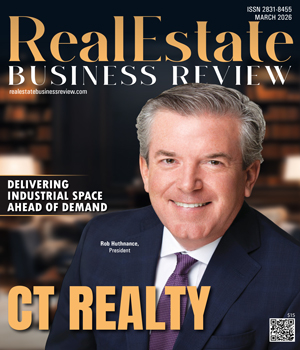
When large organizations reconfigure their supply chains, strategic planning decisions rapidly translate into tangible needs for warehouse capacity, optimal locations, and industrial facilities that support modern operations. In Tier One logistics markets, those requirements are shaped less on stated demand than on land control, entitlement certainty, and the availability of buildings designed to current specifications. Because land acquisition and permitting often occur years before leasing decisions, options are frequently constrained by the time demand is defined. As a result, industrial real estate becomes as much a timing consideration as a capacity one, with late-moving companies often limited to locations or facilities that restrict efficiency and scalability. CT Realty operates ahead of this curve as a real estate–first developer of large-scale industrial warehouse and distribution facilities in Tier One U.S. logistics markets. The firm develops industrial facilities by securing land, entitlements, and building specifications in advance of tenant commitments. “Our approach helps us to deliver high-quality warehouse space built to the standards large-scale users consistently require, without the delays that occur when development follows demand,” says Rob Huthnance, President of CT Realty. The firm focuses on the top 15 U.S. logistics markets by total warehouse square footage, where supply constraints and entitlement complexity make timing critical. These markets include Los Angeles, Chicago, Dallas, New Jersey, Atlanta, and other major U.S. distribution hubs. Within these markets, CT Realty properties are typically leased to large-scale industrial occupiers, often among the top 1,000 warehouse users nationwide.
Top Commercial Real Estate Services 2026
As businesses transition from early growth to operational scale, space becomes a critical constraint. Entrepreneurs are forced to predict how much space they need in future and to commit to fixed, long-term commercial leases. Beyond base rent, they must also manage and pay for high-speed internet, conference rooms, waste services, security and maintenance, draining capital and attention. With businesses scaling unevenly across digital and physical channels, traditional real estate models cannot support. What challenges do entrepreneurs face in scaling business space? RISE Commercial District redefines small-business real estate management by filling the gap between startup and scale with right-sized, flexible and professionally managed business districts. Its value-proposition extends beyond space. RISE functions as a growth enabler, providing businesses with the infrastructure and mentorship—on-site leadership and informal guidance—for faster growth, efficient operations and scale. “We provide everything a growing business truly needs, and no fluff they do not,” says Allison Barber, director of marketing. Turnkey Experience Boosting Business Growth How does RISE Commercial District provide a tailored environment for growth? From site selection and building design to staffing and tenant onboarding, RISE follows a standardized operating framework built around safety and service. Secure and community-driven spaces range from 300 to 3,000 square feet under short-term lease structures. Terms are intentionally straightforward, requiring only first month’s rent, which includes utilities and operational essentials, and a security deposit. Entrepreneurs can add space as their business grows, without being locked into multi-year leases.

CXO INSIGHTS

Challenges For Established Brokerages - The Tech Stack
John Currie, SVP of Operations, Weichert, Realtors

Real Estate Transaction Management: Share knowledge and experiences with peers looking for directional support
Tarrah Mueller, Senior Vice President, Director - Servicing Business Development, Northmarq

Keys to Military Housing Success
Dexter Wong, Investment Manager, Military Housing, the Michaels Organization

When Trust is Gone: Why Character is the Cornerstone of Real Estate
Matthew Holbrook, CEO, Action Property Management

The New Digital Playbook in Real Estate Engagement
Mark Hickman, Director of Digital Strategy, ONE Sotheby's International Realty

Navigating Supply Chain Challenges
Kyle Moore, Senior Vice President Of Construction, Landmark Properties

Projects Today Come Down to Nerves of Steel and Realistic Expectations
Jason D'Orlando, Executive Managing Director - America's PDS Sectors Head, and Michael Morehead, Senior Director - Industrial Lead, East Region, Cushman & Wakefield


IN FOCUS

Adapting to Change: The Evolution of Commercial Real Estate Services
Commercial real estate services are prioritizing advisory depth, sector specialization, and operational discipline as capital constraints reshape transaction-driven growth models.
Strategic Real Estate: The Key To Asset Transformation
Strategic real estate success is driven by institutional discipline, technological integration, and a rigorous commitment to sustainable development.
EDITORIAL
Controlling Risk in Dynamic Markets
Industrial real estate performance increasingly hinges on anticipation rather than reaction. As supply chains reconfigure and capital costs fluctuate, developers and operators must secure land, manage entitlement risk and align leasing timelines with infrastructure readiness. This edition of the Real Estate Business Review examines firms and leaders who shape outcomes through structured execution and forward planning.
At the center of this issue, CT Realty Partners is recognized as the Top Real Estate Development and Investment Management Company 2026. Operating across Tier One U.S. logistics markets, CT Realty secures land and entitlements years in advance of tenant demand, delivering warehouse facilities built to modern specifications before capacity constraints arise. Its Columbus campus strategy, culminating in a multi-phase development supporting Anduril Industries, illustrates how disciplined land control and infrastructure readiness translate into large-scale economic impact.
Addressing a different constraint in commercial real estate, RISE Commercial District is recognized as the Top Commercial Real Estate Services 2026. RISE bridges the gap between startup and scale by offering right-sized, professionally managed districts under flexible lease structures. By combining infrastructure, onsite leadership and peer networks, it reduces friction for entrepreneurs navigating uneven growth cycles.
Industry insight sharpens the market lens. Will Holmes, Head of Partnerships at Opendoor, highlights the growing demand for digital certainty, where tools such as cash offers and online transactions provide buyers and sellers with greater control in volatile markets. Gerard Staudt, Senior Managing Director and Head of Dispositions, North America at Savills North America, underscores the specialized discipline required to transform surplus corporate real estate into achievable pricing and cash flow outcomes.
Across development, flexible districts and corporate dispositions, structured planning defines competitive advantage. We invite readers to explore how disciplined execution and adaptive strategy are redefining real estate performance in an uncertain market.
